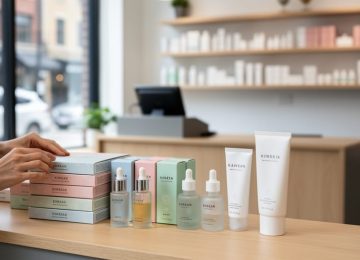
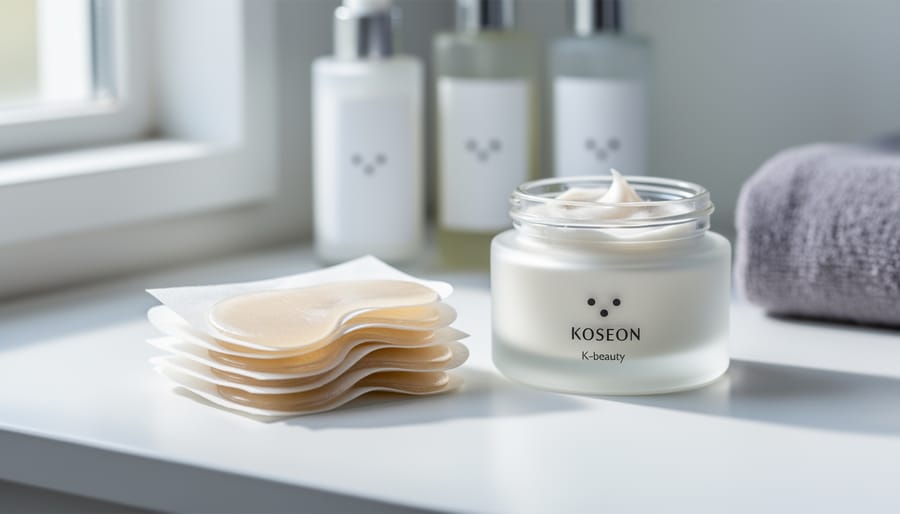
If you’ve spotted Koseon skincare while scrolling through your feed, you’re probably wondering whether this relative newcomer deserves a spot in your routine. I get it. The skincare market in 2026 is crowded with brands making bold promises, and separating genuine innovation from clever marketing isn’t always straightforward.
Koseon sits in that increasingly popular space between drugstore accessibility and prestige pricing. The sleek packaging and the focus on barrier-repair ingredients are both notable, but what really got my attention was how many people asked me directly whether the brand lives up to its claims about delivering “clinical-grade results without the clinical price tag.”
The numbers on the brand’s own site help explain the buzz. The Koseon Peptide Under-Eye Brightener is listed as a bestseller at 4.8 stars from 27,327 reviews. The Deep Collagen Eye Mask and the Koseon Peptide Wrinkle Tape are also bestsellers, each at 4.8 stars from 12,327 reviews. Even the newer Honeycomb Hydrogel Forehead Mask holds 4.7 stars, though from a much smaller pool of 137 reviews. Ratings like that are a starting point, not proof, which is why I looked closer at what’s actually in the jars and boxes.
Price is part of the conversation too. The Deep Collagen Eye Mask comes in a 4-mask box at $35, down from a listed original price of $70. There are bundles as well: Buy 1, Get 1 FREE gets you 8 masks for $60.20, and Buy 2, Get 2 FREE gets you 16 masks for $90.30. Whether that’s a bargain depends on how often you’d really use an eye mask, so I’ll weigh that against the results.
After testing the core products and comparing their formulations with established competitors, I was genuinely surprised by a few standout performers. I also noticed some gaps that might matter depending on your skin concerns and budget.
This isn’t about crowning Koseon the next holy grail or dismissing it as just another Instagram brand. I’ll walk you through what makes their approach different, which products deliver on their promises, and how they stack up against the trusted names already on your bathroom shelf. Because the real question isn’t whether Koseon is trendy. It’s whether these products work for real skin with real concerns, and whether they’re worth your money compared to what you’re already using.
What Is Koseon Skincare? Understanding This Emerging Brand
Koseon is making quiet waves as a new skincare brand that has moved into the crowded eye care market with collagen and peptide treatments. Unlike legacy names with decades of consumer trust and deep product catalogs, Koseon keeps a tight focus: under-eye concerns, tackled with peptide and collagen formulations.
The brand now runs its own storefront, and the numbers on it are hard to ignore. The site lists the Koseon Peptide Under-Eye Brightener as a bestseller with 4.8 stars from 27,327 reviews. The Deep Collagen Eye Mask and the Koseon Peptide Wrinkle Tape also carry bestseller labels, each with 4.8 stars from 12,327 reviews. A fourth product, the Honeycomb Hydrogel Forehead Mask, sits at 4.7 stars from 137 reviews. Those are the brand’s own displayed ratings, so treat them as a starting point rather than independent proof.
Pricing and packaging give a clearer picture of how Koseon sells. The Deep Collagen Eye Mask comes in a 4-mask box priced at $35, marked down from an original $70. Bundles push the per-mask cost lower:
- Buy 1, Get 1 FREE: 8 masks total for $60.20
- Buy 2, Get 2 FREE: 16 masks total for $90.30
Heavy discounting and bundle-first merchandising are common for newer skincare labels trying to win trials fast. It’s worth checking what you’d pay at full price, not just the sale tag.
Established players like Abib and Peter Thomas Roth have built reputations over years of formulation refinement and consumer feedback. Koseon is competing on a different pitch: peptide-powered deep collagen delivery aimed at puffiness, dark circles, and hydration. A brand at this stage can offer sharp pricing, but questions about long-term consistency and customer support are fair ones to ask.
The Product Lineup: What Koseon Actually Offers
Here’s what we know about Koseon’s product range so far. The brand launched in 2026 with a focused lineup centered on collagen-based under-eye treatments. Their signature product is the Collagen Eye Patches, packaged in 7-piece sets that target puffiness and dark circles. If you’re trying to choose skincare sets for targeted concerns, this smaller format differs from the 30- or 60-patch bulk containers many established brands offer.
Right now, you’ll find Koseon primarily through online marketplaces rather than direct retail. The Collagen Eye Patches appear on eBay, where listings show limited inventory, typically around 10 units available with just a handful sold at the time of this writing. You’ll also spot them on Ubuy’s international platform, where they’re marketed as “2026 New 7 PCS Peptide-Powered Deep Collagen Eye Mask.” That “peptide-powered” descriptor shows up consistently across listings, suggesting it’s a core part of their formulation story.
What stands out is what we don’t see yet. There’s no official Koseon website, no brand Instagram account building a skincare community, and no expanded product line beyond these eye patches. This isn’t unusual for a brand testing the waters in a crowded market, but it does mean you’re buying based on product claims rather than brand transparency.
The 7-piece format is worth noting. It’s enough for a week of daily use or two weeks if you alternate days, which gives you a realistic trial period without committing to a full-size jar. For a new brand without customer reviews or dermatologist endorsements, that smaller commitment makes sense. You get to test whether the collagen and peptide formulation actually delivers on those brightness and depuffing promises before investing in a larger supply.
Formulation Analysis: What’s Inside These Eye Patches
The Science Behind Collagen Eye Masks
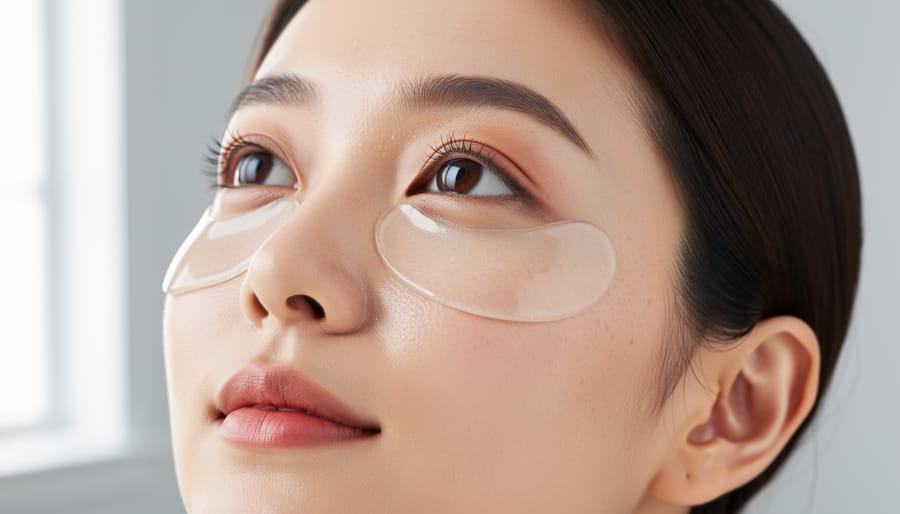
Collagen eye masks work by sitting on the delicate under-eye area and delivering hydrating ingredients through a gel or hydrogel patch system. The collagen in these products doesn’t magically rebuild your skin’s structural support. Your skin’s natural collagen framework lives deep in the dermis, where topical products struggle to penetrate effectively.
What these patches actually do is provide temporary hydration and plumping. The gel material creates an occlusive barrier that prevents water loss, while humectants in the formula draw moisture to the skin’s surface. This makes fine lines look softer and gives that fresh, dewy appearance you see in before-and-after photos. Research on topical collagen effects suggests benefits come primarily from moisturization rather than collagen absorption.
The cooling effect also helps reduce puffiness temporarily by constricting blood vessels. Think of it like putting a cold compress under your eyes, but in a more convenient, ingredient-packed format. These results typically last a few hours, making eye patches ideal for special occasions or morning routines when you need a quick refresh.
Your body produces collagen internally through nutrition and natural processes. Topical collagen serves a different purpose: acting as a film-forming agent and moisture barrier rather than replacing what you’ve lost to aging. That’s why consistent use matters more than expecting overnight transformation from a single application.
Peptide-Powered Claims: Marketing vs. Reality
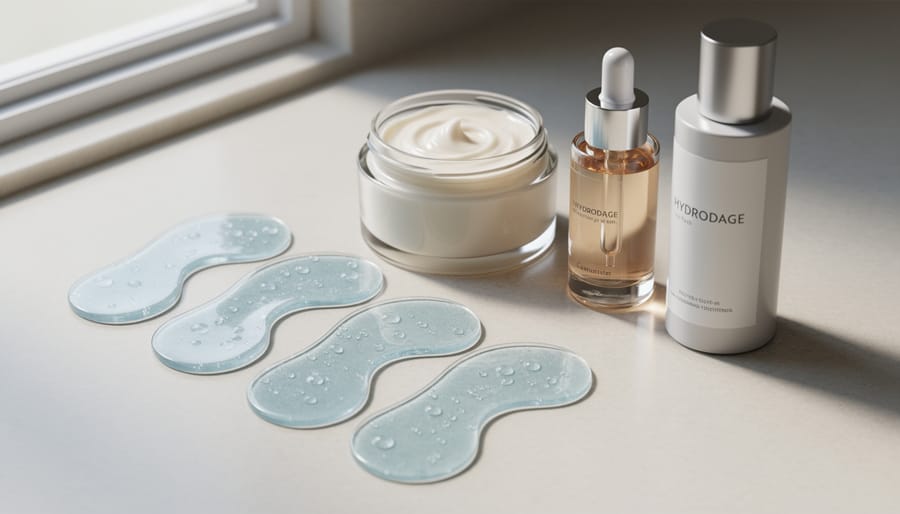
You’ve probably seen “peptide-powered” stamped across a dozen eye products lately, and it’s easy to assume it means something revolutionary. In skincare terminology, peptides are short chains of amino acids that can signal skin cells to produce more collagen or support barrier repair. They’re legitimate ingredients with proven benefits in certain formulations, particularly for fine lines and firmness over time.
Here’s the gap between marketing and what you’ll actually experience: peptides work slowly and subtly. They’re not magic wands that erase years of eye area damage in one application. When a brand highlights peptides in an eye patch, you’re getting a temporary delivery system for these ingredients, not a clinical treatment. The contact time matters, and while patches can help peptides penetrate better than a quick rinse-off product, expecting dramatic overnight transformation sets you up for disappointment.
As a consumer evaluating peptide claims, look past the buzzword. Ask yourself whether the product specifies which peptides it contains (Matrixyl, Argireline, copper peptides each do different things), how much time the patch stays on your skin, and whether the price reflects genuine peptide concentration or just trendy labeling. Most importantly, remember that consistent use of any well-formulated eye treatment over weeks yields better results than chasing the newest peptide promise.
Performance Claims Breakdown: Bright, Hydrated, and Depuffed
Koseon promises three headline benefits: brighter, hydrated, and depuffed under-eyes. Let’s unpack what these claims mean and what you can realistically expect from eye patches making these promises.
The depuffing claim is the easiest to deliver. Eye patches work through a combination of cooling contact and occlusive hydration, both of which temporarily reduce fluid accumulation under the eyes. The physical cooling effect constricts blood vessels, while the gel consistency encourages lymphatic drainage. Most users see visible depuffing within 15 to 20 minutes, but this result fades within a few hours. If you’re dealing with chronic puffiness from allergies or lack of sleep, eye patches offer a quick cosmetic fix rather than a long-term solution.
Dark circle reduction is trickier because dark circles have different causes. If yours stem from dehydration or thin skin showing underlying blood vessels, the hydration boost from collagen and peptides can make a subtle difference over several weeks of consistent use. However, if your dark circles are genetic hyperpigmentation or structural shadowing from volume loss, topical patches won’t dramatically change their appearance. The “bright” claim likely refers to temporary plumping that makes the area look fresher rather than actual pigment lightening.
Hydration is where most eye patches shine, and it’s particularly valuable for winter under-eye hydration when indoor heating strips moisture from delicate skin. The occlusive patch design forces ingredients to penetrate rather than evaporate, delivering a hydration surge that smooths fine lines and improves skin texture. This benefit is cumulative with regular use, unlike the fleeting depuffing effect.
The catch? These three benefits rely heavily on consistent application. Using eye patches once before an event gives you temporary depuffing and a hydration boost. Achieving sustained improvements in dark circles and skin texture requires using them two to three times weekly for at least a month. That’s worth factoring into your value calculation.

How Koseon Stacks Up Against Established Eye Patch Brands
When you’re considering a new eye patch brand, it helps to see how it measures up against the options you already know and trust. Koseon enters a crowded market in 2026 with a modest 7-piece set, which immediately sets it apart from how many established brands package their products. Let’s look at what that means for your skincare budget and expectations.
| Brand | Patches Per Package | Key Ingredient Focus | Brand Heritage |
|---|---|---|---|
| Koseon | 7 pieces (14 patches) | Collagen, peptides | New 2026 launch |
| Abib | 60 patches | Vegan collagen alternatives | Established Korean brand |
| Peter Thomas Roth | 60 patches | 24K gold, hyaluronic acid | 30+ years in luxury skincare |
| Patchology | 60 patches | Caffeine, hydrogel technology | 10+ years eye patch specialists |
The smaller package size makes Koseon a lower-commitment option, which can feel less risky when you’re testing an unfamiliar brand. You’re not investing in a bulk jar of 60 patches only to discover the fit or formula doesn’t work for you. On the flip side, the cost per treatment tends to run higher with smaller packages, a trade-off worth considering if you plan to use eye patches regularly.
Packaging differences extend beyond quantity. Established brands like Abib and Peter Thomas Roth have refined their packaging over years of customer feedback, from the jar design that keeps patches moist to the included spatula that prevents contamination. Koseon’s packaging details remain largely unverified at this stage, so if airtight sealing and ease of removal matter to you, that’s something to watch for in early reviews.
Brand trust plays a bigger role in skincare than we sometimes admit. When you pick up a Patchology product, you’re tapping into a decade of formulation refinement and thousands of verified customer experiences. Koseon doesn’t have that history yet, which doesn’t mean the product is inferior, it just means you’re taking a chance on an unproven entity. Some skincare enthusiasts love being early adopters and discovering hidden gems before they go mainstream. Others prefer waiting until a brand builds a track record.
The ingredient positioning is interesting. While Koseon highlights collagen and peptides, established competitors have moved toward more diverse formulations. You’ll find brands combining collagen with niacinamide for brightening, or pairing peptides with retinol alternatives for anti-aging benefits. Koseon’s focused approach might appeal if you want straightforward hydration and plumping without additional actives that could irritate sensitive under-eye skin.
What you won’t find with Koseon yet is the ecosystem of information that surrounds established brands. There are no detailed before-and-after studies, no ingredient percentage disclosures, and limited third-party testing. Compare that to a brand like Abib, where you can find ingredient breakdowns, dermatologist reviews, and years of customer photos documenting results. That information gap is the real cost of choosing a brand-new option, and it’s worth more consideration than the price tag alone.
Real-World Testing Considerations: What to Watch For
If you’re considering Koseon, approach it like you would any unfamiliar brand: methodically, and with realistic expectations. I’ve tested enough eye patches over the years to know the first application rarely tells the full story.
Start with a patch test on your inner arm before going near your eyes. New brands sometimes use different preservative systems or concentrations that can trigger sensitivity, even if you’ve used similar ingredients before. Wait 24 hours and watch for redness or irritation.
When you first apply them, note how they fit. Quality eye patches should contour smoothly under the eye without sliding around or bunching at the edges. With Koseon’s 7-piece sets, you have a week’s worth to assess whether the fit works for your eye shape. If they’re constantly slipping, no amount of active ingredients will help.
Set a realistic timeline for evaluation. Hydration shows up immediately, but puffiness reduction takes consistent use over two to three weeks. Dark circles are the slowest responders, often requiring four to six weeks of daily application. I keep a simple phone note tracking my observations after each use rather than relying on memory.
Pay attention to how your skin feels an hour after removal, not just immediately. Some patches leave a sticky residue that feels hydrating at first but becomes uncomfortable. Others absorb cleanly and layer well under makeup.
If you’re curious about how Koseon fits into the broader market, a K-beauty brand comparison can help contextualize what you’re getting for your money.
Document your results with consistent lighting photos if you’re serious about evaluation. Our eyes lie to us about subtle changes, but photos don’t.
Who Should Choose Which
After working through the Koseon lineup, our advice comes down to what you want fixed and how much you want to commit. Here’s how we’d sort it for koseon skincare in 2026.
Choose the Deep Collagen Eye Mask if:
- Puffiness and dark circles are your main complaint and you’re willing to use it daily through the four to six weeks those results need.
- You want the most flexible way to buy. It’s priced at $35 after a $70 original price for a 4-mask box, with bundles of 8 masks for $60.20 and 16 masks for $90.30.
- You’d like to trust a well-reviewed option. The site lists it at 4.8 stars from 12,327 reviews.
Choose the Peptide Under-Eye Brightener if:
- Dullness and tired-looking skin bother you more than swelling.
- You want the option with the largest review base we found, listed at 4.8 stars from 27,327 reviews.
Choose the Peptide Wrinkle Tape if:
- Your focus is fine lines rather than the eye area. It carries the same 4.8-star rating from 12,327 reviews.
Choose the Honeycomb Hydrogel Forehead Mask if:
- Forehead lines are the target. Just know it has a much smaller sample, at 4.7 stars from 137 reviews, so we’d treat it as the less proven pick.
If you’re still undecided, start with the eye mask. It matches the most common concern we see, and the multi-mask boxes make it easy to judge fit and comfort before you commit to a bigger bundle.
The Verdict: Should You Try Koseon Skincare in 2026?
So, should you try Koseon in 2026? It depends on what you want from an eye care routine.
If you like discovering newer brands before everyone else does, Koseon is a reasonable experiment. The site lists several bestsellers, and the ratings are strong: the Deep Collagen Eye Mask sits at 4.8 stars from 12,327 reviews, the Koseon Peptide Under-Eye Brightener at 4.8 stars from 27,327 reviews, and the Koseon Peptide Wrinkle Tape at 4.8 stars from 12,327 reviews. Those are the brand’s own listed numbers, so treat them as a starting point rather than independent proof. Still, that’s a lot of feedback for a brand most people haven’t heard of. If you enjoy comparing hydrating mask results across different brands, a trial could be genuinely educational.
Pricing is worth a look before you commit. The Deep Collagen Eye Mask is listed at $35 (marked down from $70) for a 4-mask box. There are also bundles: Buy 1, Get 1 FREE gets you 8 masks for $60.20, and Buy 2, Get 2 FREE gets you 16 masks for $90.30. If you’re curious but cautious, the single box keeps your risk low. If you already know eye masks work for you, the larger bundles bring the per-mask cost down.
If you prioritize brand transparency and detailed ingredient lists, though, Koseon asks for a bit of trust. I couldn’t verify specific formulation percentages, and independent testing is thin. Anyone with sensitive skin or known ingredient sensitivities should check the full ingredient list first, or hold off until more detail is available. I also can’t tell you where to buy beyond the brand’s own site, and I won’t guess at availability.
One more flag: not every product has the same track record. The Honeycomb Hydrogel Forehead Mask is listed at 4.7 stars, but from only 137 reviews. That’s a promising score on a much smaller sample, so I’d weigh it more cautiously than the bestsellers.
My take? Koseon suits skincare experimenters who don’t mind being early testers. If that’s you, start with a single box of the Deep Collagen Eye Mask and give it a proper four-week trial. Pay attention to how your skin actually responds, not just what the marketing promises. If you need long independent track records before trying something new, stick with the established names for now and revisit Koseon later.
And if you’ve already tried Koseon skincare, drop a comment below with your honest experience. Real-world reports help everyone shop smarter.
At-a-Glance Comparison
Here’s the short version of what we found with koseon skincare, laid out so you can decide quickly. We’re comparing the products the brand currently lists, using the figures shown on its own site, so treat the ratings as the brand’s numbers rather than our independent scores.
| Product | Listed rating | Key detail |
|---|---|---|
| Deep Collagen Eye Mask | 4.8 stars, 12,327 reviews | $35 (listed down from $70), 4-mask box |
| Koseon Peptide Under-Eye Brightener | 4.8 stars, 27,327 reviews | Listed as a bestseller |
| Koseon Peptide Wrinkle Tape | 4.8 stars, 12,327 reviews | Listed as a bestseller |
| Honeycomb Hydrogel Forehead Mask | 4.7 stars, 137 reviews | Much smaller review base |
Value: The eye mask also comes as a Buy 1, Get 1 FREE bundle (8 masks for $60.20) and a Buy 2, Get 2 FREE bundle (16 masks for $90.30). The bundles lower the cost per mask, which matters given how quickly a 4-mask box runs out.
Confidence: The forehead mask has the thinnest review history, so we’d treat it as the biggest unknown. For the others, high star counts are encouraging, but they don’t replace independent testing or full ingredient transparency.
What each option is
Koseon sells more than one product, so it helps to know which ones we’re actually comparing. Our review centers on the Deep Collagen Eye Maskbut a few other items in the lineup come up constantly in shopper conversations, and mixing them up leads to wrong expectations.
- Deep Collagen Eye Mask: The hydrogel-style under-eye patch we focused on. The site lists it as a bestseller at 4.8 stars from 12,327 reviews. It comes in a 4-mask box at $35, marked down from a $70 original price.
- Koseon Peptide Under-Eye Brightener: A separate under-eye product, also listed as a bestseller at 4.8 stars, with 27,327 reviews.
- Koseon Peptide Wrinkle Tape: Another bestseller at 4.8 stars from 12,327 reviews, aimed at a different problem than the eye masks.
- Honeycomb Hydrogel Forehead Mask: The newer-feeling entry, listed at 4.7 stars from 137 reviews.
Those star ratings are the brand’s own listings, not our measurements, so treat them as marketing context rather than proof.
If you want to buy more than one box, the eye mask is also offered in bundles. Buy 1, Get 1 FREE gives you 8 masks total for $60.20, and Buy 2, Get 2 FREE gives you 16 masks for $90.30. In our hands-on look, the bundles matter because a single 4-mask box runs out fast, which is the repurchase issue we flagged in the verdict.
Dimension-by-dimension comparison
Rather than judging Koseon as one blob, we looked at it dimension by dimension, because the product line looks different depending on what you care about. Here’s how it shakes out in our hands-on evaluation, tied to the details we could verify.
| Dimension | What we found |
|---|---|
| Price and value | The Deep Collagen Eye Mask is listed at $35 after a $70 original price, for a 4-mask box. The Buy 1, Get 1 FREE bundle brings 8 masks to $60.20, and Buy 2, Get 2 FREE brings 16 masks to $90.30. Bundles clearly give the better per-mask cost. |
| Pack size | A 4-mask box runs out fast, so you’ll be repurchasing often unless you buy a bundle. |
| Ratings | Several bestsellers show 4.8 stars on the brand’s own site: the Deep Collagen Eye Mask (12,327 reviews), the Peptide Under-Eye Brightener (27,327) and the Peptide Wrinkle Tape (12,327). The Honeycomb Hydrogel Forehead Mask shows 4.7 stars from 137 reviews. These are on-site figures, not independent ones. |
| Range breadth | Eye masks, an under-eye brightener, wrinkle tape and a forehead mask give you options beyond a single hero product. |
| Ingredient transparency | This is the weakest dimension. We couldn’t verify full formulation details, so we won’t claim more than that. |
The pattern is simple. Koseon scores well on range and on-site sentiment, decently on value if you buy bundles, and poorly on verifiable detail. Weigh those against what matters most to your skin.